Sweden has set ambitious climate targets, aiming for net-zero emissions by 2045 and negative emissions thereafter. As one of the world’s early adopters of carbon pricing and renewable energy, Sweden faces unique challenges in decarbonizing hard-to-abate sectors while maintaining its competitive industrial base and energy security.
Key challenges include phasing out remaining fossil fuel use in industry and transport, integrating variable renewables at scale, and balancing electrification with sustainable bioenergy use—all while preserving Sweden’s position as a clean energy leader.
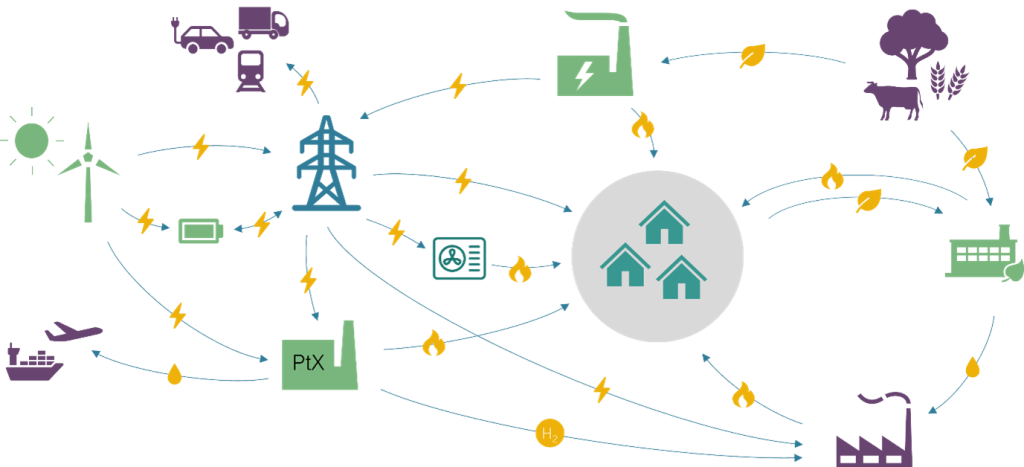
Energy Modelling Lab has developed TIMES-SE, a comprehensive energy systems model for Sweden. This modeling framework captures the interactions between electricity, heating, industry, transport, and other key sectors. By analyzing different technology pathways and policy scenarios, TIMES-SE helps identify cost-effective strategies for deep decarbonization. The model enables exploration of optimal investment timing, technology choices, and sector coupling opportunities to support Sweden’s climate ambitions.
MODELLING We have built a tailored energy systems model, the TIMES-SE, using the TIMES energy systems modelling framework developed under IEA.
The model includes a full investment catalog for the entire energy sector and shows the economically optimal pathways through the jungle of technological solutions.
SCENARIO ANALYSIS Through a series of scenarios, we can investigate the consequences of different climate scenarios and consider prioritized mitigation actions.
DOCUMENTATION The model documentation can be found here soon.
The overall goal of the PtX Infrastructure project is to evaluate Danish investment options for hydrogen and CO2 infrastructure. The results should support Danish green fuel production in the context of an integrated, sector-coupled European energy system.
The project is a research project carried out by eight partners. EML contributes to the project with our advanced energy systems modelling expertise. We will use the energy systems model TIMES-NEU to generate scenarios for detailed analyses.
The expected results are forecasts and estimates of the following:
Hydrogen demand evolution in each region, including hydrogen as a feedstock for e-fuels production (e-methanol, ammonia).
Size of Danish H2 export market and potential countries to export to.
Electricity demand in Denmark, Sweden, Norway, Germany, and Poland at sector level.
CO2 trajectory for Power and Heat sector.
CO2 use and storage.
Identified research gaps
Currently, the number of analyses of feasible CO2 infrastructures and H2 and CO2 storage is limited. Furthermore, the partners in the project are addressing another three research gaps that have been identified:
Silo thinking when optimising energy infrastructures.
National foci when developing PtX plans.
Poor representation of uncertainty and robustness in investment planning.
To bridge the gaps, the project partners will apply and further develop three state-of-the-art energy system models to encompass a holistic energy system perspective. The three models in question are Balmorel, PyPSA-Eur-Sec, and TIMES.
The partners design common scenarios and explore the results to understand differences, enhancing the robustness of the results. An essential part of the project is carrying out a detailed uncertainty analysis.
Advantages of the TIMES-NEU model
When using the TIMES-NEU model, the Danish energy system is analysed within the framework of the European energy system.
The TIMES-NEU model represents the entire energy system of Norway (NO), Denmark (DK), Sweden (SE), Germany (DE), and Poland (PL), covering all sectors to assess future hydrogen and electrofuel demand. Furthermore, it has data on the Netherlands, Belgium, and the UK.
It includes key hydrogen and CO₂ infrastructure and detailed sectoral modelling for aviation and shipping, incorporating technology developments for electro fuel adoption. Additionally, the model provides an in-depth analysis of iron, steel, and other industries, evaluating the competition between hydrogen and electrification pathways.
With 56 time slices per year, the model captures seasonal and intra-annual variations, while global market trade with 40 energy carriers ensures a comprehensive representation of international energy flows.
EML developed the TIMES-NEU model in 2022 using the TIMES energy systems modelling framework. TIMES is internationally recognized and developed under the Energy Technology Systems Analysis Program (ETSAP).
MissionGreenFuels partnership
The PtX Infrastructure project is implemented under the aegis of the MissionGreenFuels partnership, which is one of the four Innomissions launched by the Danish Innovation Fund. Innomission is funded by a 700 million DKK grant from the Danish government and funds from the NextGenerationEU program. The second phase of the project started in 2025.
The American company Brightcore Energy has assigned EML to build a tailored energy systems model, the TIMES-Arlington model. The company can use the model to make recommendations for investments in new technologies regarding renewing and optimizing energy supply.
The model represents a school’s heating and cooling systems and an adjacent neighborhood in Arlington, Massachusetts. At the outset, the systems are supplied by only natural gas (main source) and some electricity. The buildings have individual AC units.
EML has considered local resources such as river and sewage water. In numerous scenarios, we have tested production, storage, and grid capacities, and space heat, space cooling, and hot water production in different combinations of technologies.
Our initial analysis has shown that a mix of geothermal and air-source pumps is the most feasible and lowest-cost solution for a future system.
Total discounted costs of systems
The analysis included the costs of grid expansion and the building of new pipes. Furthermore, we tested the optimal percentage of residential houses to be connected to the different kinds of pumps. We could demonstrate significant differences in total discounted costs of systems between tested mixes.
In addition to total system costs for different technology mixes, our analysis included CapEx breakdowns and estimates of primary energy supply and final energy consumption.
The TIMES-Arlington model is set to optimize the system for the milestone years 2024, 2030, 2040, and 2050.
Load profiles and accurate system sizing
To ensure accurate system sizing according to the load demands and to reflect peaks, we selected eight representative weeks based on load profiles. Each selected week captures the load behavior of a specific season. The resulting time series distinguishes between weekdays and non-weekdays and represents 24 hours per day. This method also minimizes computational time.
MODELLING
The TIMES-Arlington model is developed using the TIMES energy systems modelling framework. It represents a school’s heating and cooling systems and an adjacent neighbourhood in Arlington, US.
SCENARIOS
We have tested production, storage, and grid capacities, and space heat, space cooling, and hot water production in scenarios with different combinations of technologies.
REPORT
In addition to total discounted system costs of different technology mixes, our analysis included CapEx breakdowns and estimates of primary energy supply and final energy consumption.
Trollhättan Energi is developing district heating in Trollhättan and has assigned EML to develop a customized energy systems model, the TIMES-TE model. The model is used as a tool to analyze existing district heating operations, explore options for new technologies, and identify cost-optimal solutions.
Consequently, EML has generated about 30 scenarios, allowing for an in-depth analysis and testing of multiple options. The model data spans the period 2027- 2040.
Among the results of the scenario analysis were recommendations for phasing out some existing plants over time, investing in heat pump technology, and not reinvesting in certain plants.
Furthermore, we estimated the payback time for recommended investments in heat pump technology.
Identifying waste heat potential
Trollhättan Energi provides heating to 18,000 homes and 300 companies in the Swedish city of Trollhättan. The Company has set a strategic aim that its energy production should be fossil-free by 2030.
The TIMES-TE model has a representation of available energy resources, including not yet exploited sources such as wastewater. Waste heat potential in Trollhättan was identified using registers of all municipal activities and mapping through GIS modelling.
The TIMES-TE model can be regularly updated and used as a tool for continuous strategic energy planning, dovetailing system developments, and financial planning.
MODELLING
EML used the TIMES energy systems modelling framework to develop a customized model of the district heating network in Trollhättan, the TIMES-TE model.
SCENARIOS
An analysis of about 30 scenarios testing different assumptions, technology options, and targets was accomplished.
REPORTING
We produced a comprehensive report of the results that supported the decision-making of the management of Trollhättan Energi.
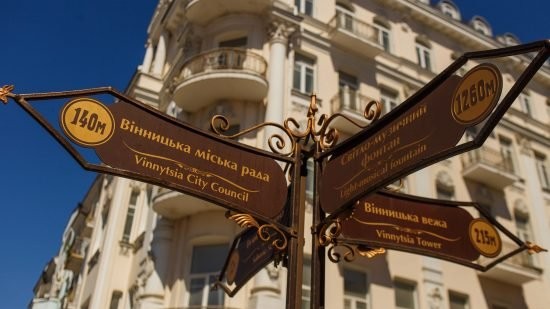
Vinnytsia municipality has engaged in a project to develop a comprehensive district heating investment roadmap, innovating energy planning in Ukraine. As part of the project, the Energy Modelling Lab is building the TIMES-Vinnytsia energy systems model.
The model enables energy planners to identify the most cost-effective and sustainable solutions to modernize the district heating system. It covers the period 2025-2050. Subsequently, Vinnytsia’s energy planners can adopt a long-term strategic approach, allowing for informed decisions on priority investment projects.
Building the TIMES-Vinnytsia model entails mapping available local energy resources such as river water, wind, waste energy, geothermal, and solar. Furthermore, we will assess the feasibility of using these sources in the local district heating system. Likewise, we will analyze current assets to determine which ones should be replaced or retrofitted and identify opportunities for system expansion.
20-30 scenarios for modernizing the district heating system
We expect to develop and analyze 20-30 scenarios for modernizing the district heating system. The scenarios will show the impact of factors such as energy taxation policies, choice of energy resources, alignment with EU legislation (e.g., EU Taxonomy), the resilience of the energy system (technology combinations, storage solutions), the marginal cost of production, potential grid expansion, and energy efficiency investments in buildings.
The analysis of the scenarios will result in a roadmap for 2025-2050 outlining recommended investments, timing, and costs.
The TIMES-Vinnytsia will have a representation of the heat supply balance including storages and demands and showing centralized and individual options.
Vinnytsia first in Ukraine to announce the Green Deal
Vinnytsia has 370.000 inhabitants. It is located on the banks of the Southern Bug and is a prominent industrial city. Vinnytsia City Territorial Community was the first in Ukraine to announce the Green Deal following the example of the European Green Deal.
The district heating systems in Ukraine supply about 40 pct. of the residents during the heating season. The National Renewable Energy Action Plan (NREAP) has set ambitious targets to increase the share of renewable energy in heating and cooling from 20.8% to 32.5% by 2030.
MODELLING
Building the TIMES-Vinnytsia model. We use the TIMES energy systems modelling framework. It was developed as a methodology for energy scenarios to conduct in-depth energy and environmental analyses by ETSAP, a technology collaboration program under the IEA.
SCENARIO ANALYSIS
Generating and analyzing 20-30 scenarios of modernizing the Vinnytsia district heating system considering the impact on demand and production by factors such as energy taxation policies, choice of energy resources, alignment with EU taxonomy, and energy system resilience.
ROADMAP
Developing a Roadmap 2025-2050 detailing recommended priority investment projects, timeline, and costs. The Roadmap will support the energy planners of Vinnytsia Municipality in making informed choices and enable long-term strategic planning.
There is a great flurry of activity to report on in our Newsletter 2024. As a new development, we have strengthened our expertise in building models representing local entities such as district heating networks, municipalities, islands, and building complexes.
Furthermore, we have continued developing a new module for the TIMES Modelling Framework representing the AFOLU sector (Agriculture, Forestry, Land Use). We have also continued to collaborate on the research projects MissionGreenFuels and SpeedLocal.
In total, we have been working on no less than 12 models. We have built four new TIMES models, updated and further developed three models, started working on two models, and supervised the creation of three models.
This collective research paper proposes a novel framework to be applied when modelling hydrogen in sector-coupled energy systems.
Hydrogen is expected to play a key role in achieving a carbon-neutral energy system in the future. Therefore, the modelling of hydrogen is becoming an increasingly integrated part of sector-coupled energy system modelling tools. However, results from different models and scenarios show different needs for hydrogen infrastructure and the deployment of electrolyzers. There is, therefore, an urgent need for transparent communication of the main modelling features and input data that can impact the results related to hydrogen production in national energy systems.
The paper was posted on SSRN, on December 21, 2024.
EML-Team: Kenneth Karlsson and Andrea Marin Radoszynski
Collaborators: Marie Münster, DTU; Rasmus Bramstoft, DTU; Lars Bregnbæk, Nicolas Campion, DTU; Mathias Kjærgård Christensen, and Dimitrios Eleftheriou, Christos Koumparakis, DTU; Ioannis Kountouris, DTU; Jakob Zinck Thellufsen, Aalborg University; Meng Yuan, Aalborg University, and Henrik Lund, Aalborg University.
We have co-authored the article City Energy Planning: Modeling Long-Term Strategies under System Uncertainties. The article was published in Energy Strategy Reviews, Volume 56, November 2024.
The study explores the role of city energy plans on future cost-efficient energy systems. A technology-rich cost-optimization model was developed using TIMES with intra-sectoral and inter-sectoral interactions and applied to the Gothenburg energy system.
The model outcomes are investigated with the application of policy-driven scenarios. The model is further tested under system uncertainties and price sensitivities identified using a participatory approach.
Collaborators: Professor Erik Ahlgren, Department of Space, Earth, and Environment, and PhD student Kushagra Gupta, Chalmers University of Technology, Sweden
Cities account for about 66 pct. of the total final energy consumption and more than 75pct. of global CO2 emissions. Subsequently, the green transition of city energy systems is key to reaching climate targets. We are supervising a PhD project focusing on city energy planning and modelling the Gothenburg city energy system as a case study.
The PhD is entitled “Policy-driven long-term development of city energy systems” and written by Kushagra Gupta at Chalmers University of Technology, Sweden.
The objectives of the research
To investigate how the city’s energy plans drive the long-term development of the city’s energy system.
To explore how the city energy plans coordinate with the national climate targets from a long-term perspective.
To identify optimal pathways for allocating resources to competing sectors during the transition.
Methodology
We have built a tailored energy systems model, the TIMES-NE city model. The model allows us to investigate the impact of the city energy plan on the long-term energy systems development.
The model represents a Northern European city setting. It’s based on the TIMES modeling framework developed and maintained by the IEA-ETSAP (International Energy Agency – The Energy Technology Systems Analysis Program).
The model has a representation of developments in the supply and demand side of the heating, electricity, and transportation sectors. The time horizon is from 2018-2050. The temporal resolution of the model is 12*24 to incorporate seasonal and hourly variations. The spatial boundary covers the area within the control of the municipal authorities. The city is further divided into multiple segments based on demographics.
Novelty of the study
The novelty of the study lies in adopting an integrated model approach. This approach allows for exploring intra- and inter-sectorial linkages.
Furthermore, this study explores the supply and demand side whereas most studies focus on either the supply or demand side. Subsequently, it enables us to account for the competition of resources among sectors.
Another important characteristic of this modelling study is the inclusion of customer perspective in investment decisions.
Scenarios
We are developing four scenarios for our analysis:
1) The reference scenario (REF) extends the base year model over the modelling time horizon. Already adopted national policy instruments such as energy and carbon tax, reduction obligations for the transport sector are included in the reference scenario. No additional policy measures or system improvements take place. Historical trends are projected into the future to evaluate the demands and shape a reference energy system.
2) The City Energy Plan scenario (CEP), in which the main goals identified under the Gothenburg Energy Plan 2021-2030 are applied and tested.
3) Integrated National Energy and Climate Plan (INEP), in which the national climate targets for Sweden are translated into targets for the city.
4) EU-Effort Sharing regulation (EU-ESR), Similar to INEP, in this scenario, Sweden’s commitment to EU-ESR is translated into climate targets for the city.
Gothenburg Energy Plan
The purpose of the energy plan is to promote the implementation of measures that lead to the city of Gothenburg reaching the environmental goal for the climate in the City’s Environmental and Climate Program 2021-2030.
The environmental and climate program 2021-2030 is the starting point for the energy plan. The plan describes how the City of Gothenburg will work to achieve the energy-related goals in the program.
Within the Gothenburg energy plan, the city has interim goals for the climate:
· The city of Gothenburg reduces energy use in homes and premises.
· The City of Gothenburg only produces energy from renewable sources.
· The city of Gothenburg reduces the climate impact of transport.
· The City of Gothenburg reduces the climate impact of purchasing.
The plans cover the energy produced or used within the municipal geographic area, the energy produced by the city of Gothenburg, and the energy used by municipality employees when traveling outside.
Institution: Chalmers University of Technology, Sweden
University Supervisor: Professor Erik Ahlgren, Department of Space, Earth and Environment
We have made a quantitative impact assessment related to load distribution for Varmelast. The impact assessment is part of the project Load Distribution based on Contract Prices. The aim of the project is improving the competitiveness of district heating.
Varmelast handles load dispatching of heat production in the greater Copenhagen area. Varmelast is organized as a cooperation between the three largest municipally owned heating companies in the Copenhagen metropolitan area: CTR, VEKS, and HOFOR.
Varmelast has published the EML report on Varmelast.dk.
One fundamental way of improving the competitiveness of district heating is to reform the load distribution system to ensure the lowest possible heating prices. Our analysis focused on the pricing of load distribution, comparing the advantages of different pricing systems.
Comparing load distribution systems
We based the assessment on the model TIMES-Varmelast. TIMES-Varmelast is an optimization model we built and tailored based on the internationally recognized TIMES modelling framework.
In the model, a load distribution system based on the contract prices is tested and compared with the existing system load distribution system based on minimizing the total costs of running the plants (e.g., fuel costs and revenue from the sale of electricity which are not part of the heating contract).
The analysis examines the total variable heat payment in 2030 under the two load distribution systems. The purpose was to contribute to understanding how changes in load distribution, and design of future contracts can affect the future heat price and production. Likewise, we also wished to gain insights into how electricity price assumptions and fuel price assumptions can affect future heat prices and production.
The TIMES-Varmelast model
The TIMES-Varmelast model is solved on an hourly level (8760 hours). We equipped it with a detailed representation of the greater Copenhagen district heating area. The model features 98 regions representing relevant district heating supply, transmission, and demand areas.
TIMES-Varmelast was developed from scratch within a few weeks by EML. The successful result has demonstrated the strength and flexibility of the TIMES modelling framework. Furthermore, we confirmed our ability to apply the TIMES framework quickly to any complex energy system case.
Key takeaways
Adopting the format of price-based contracts for load distribution results in substantial reductions in the costs and lower prices of district heating compared to cost-based load distribution.
Operating the format of price-based contracts for load distribution results in using the cheapest production plant at any given time.
Using the format of price-based contracts for load distribution results in considerable change in the district heating production. The impact includes decreased production from thermal plants while production from heat pumps and electric boilers increases.
The format of price-based contracts for load distribution is more robust to changes in electricity prices.
Modelling
We used the TIMES modelling framework to build the TIMES-Varmelast model for load distribution with different pricing systems, hourly time resolution, and detailed representation of the Greater Copenhagen district heating area.
Scenarios
We developed scenarios comparing price-based contracts for load distribution to the existing load distribution system (based on total costs) and ran sensitivity analyses.