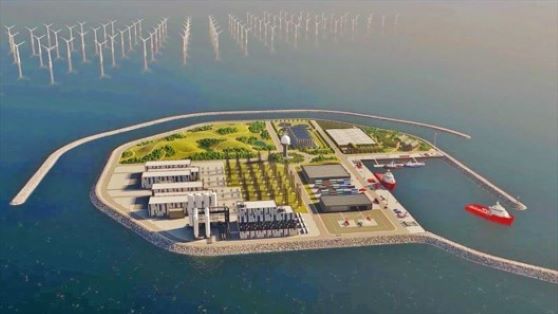
Energy Modelling Lab developed a model for planning energy islands that maximises economic return, using a price driven approach rather than the more conventional demand driven approach. The model was applied in a master’s thesis examining the strategic development of a North Sea energy island, supervised by Kenneth Karlsson and carried out by Francisco Gonzalez Beltran at the Technical University of Denmark. The work responds to EU ambitions to strengthen energy security and reduce dependence on imported fossil fuels.
The model explores the optimal scale for producing e-fuels, including hydrogen, ammonia, methanol and kerosene, on the island, alongside cost efficient options for transmitting electricity to shore. It runs at hourly resolution to capture storage operation in detail and to make the results more reliable, and it generates scenarios that test how different conditions affect operations, capacity, investment and profitability.
Germany, Denmark and a hydrogen hub
Germany and Denmark were found to be the most viable markets for electricity exports. Exporting hydrogen to the Netherlands and Belgium was the most economically attractive option, reflecting high industrial demand and favourable pricing in those markets. Other e-fuels are only viable under specific high price conditions, so the island functions best as a hydrogen hub. Hourly resolution proved important for understanding storage operation and for producing reliable results.
The model is built on the TIMES framework and applied to a North Sea energy island at hourly resolution, with some simplification of electricity markets and transport operations.